


Last night’s performance at Kolarac Concert Hall was another evening of exceptional classical music. Armenian violinist, Sergey Khachatryan, and the Belgrade Philharmonic Orchestra, led by guest conductor Christoph König, charmed the audience with their impressive talent and skill! They were brilliant!

Concert In Memory of Gabriel Feltz & Zoran Djindjić
The beautiful concert was dedicated to the memory of Zoran Djindjić and Gabriel Feltz – the first “democratically elected” Prime Minister of Serbia and the former Chief Conductor of Belgrade’s Philharmonic Orchestra. König shared his memories as a young pianist meeting Feltz at HfM, the music academy in Dresden. He expressed his admiration for him and shock and sorrow at his untimely death. It’s tragic when those with so much potential die at such a young age. Both are deeply missed:
- Dr. Zoran Djindjić (1952-2003) – politician, philosopher, and first democratically elected Prime Minister Republic of Serbia
- Gabriel Feltz (1971 – 2025) – former Chief Conductor of the Belgrade Philharmonic Orchestra

Program
The program included:
- Jean Sibelius Violin Concerto Op. 47 – masterpiece cornerstone of violin repertoire
- Franz Schmidt Symphony No. 4 – requiem for Schmidt’s daughter who died unexpectedly
Jean Sibelius Violin Concerto D Minor
Sibelius’ concerto is described as a “one-of-a-kind musical masterpiece“. He’s recognized as “a 19th century giant of musical imagery”. The first “off-the-beat dissonant note” played by a violin soloist sets the tone for a “captivating melody”.
Sibelius’ music paints a picture of the nature and landscape in Finland, his homeland. The character of his Violin Concerto “has been compared to that of the Nordic people,” with some defining it as a description of Finland’s “actual as well as human nature“.

_____________
“Jean Sibelius is not just Finland’s most famous composer, he’s a cultural colossus and national hero who played a symbolic role in Finland’s quest for independence.” The Imaginative Conservative
_____________
Unlike many other composers, Sibelius’ concerto gives the “orchestra a central role in direct dialogue with the soloist“. His work “influenced later works by Russian composers Sergei Prokofiev and Dmitri Shostakovich“. The “soloist’s delicate introduction” stands out as a “contrast to the big orchestral openings of 19th century composers like Richard Wagner“.

Sibelius trained to be a classical violinist and “dreamed of being a virtuoso“. He dedicated years to mastering the violin, but “struggled with stage fright and overcoming the fact that he started learning relatively late,” at the age of 14. Some say Sibelius composed the Violin Concerto “for the kind of player he never got to be“. Last night, Khachatryan’s artistry did Sibelius’ concerto justice.
_____________
“Jean Sibelius (1865–1957) was a pivotal cultural figure in Finland’s quest for independence from Russia. His music and compositions forged national identity and served as covert symbols of freedom and national pride.”
_____________
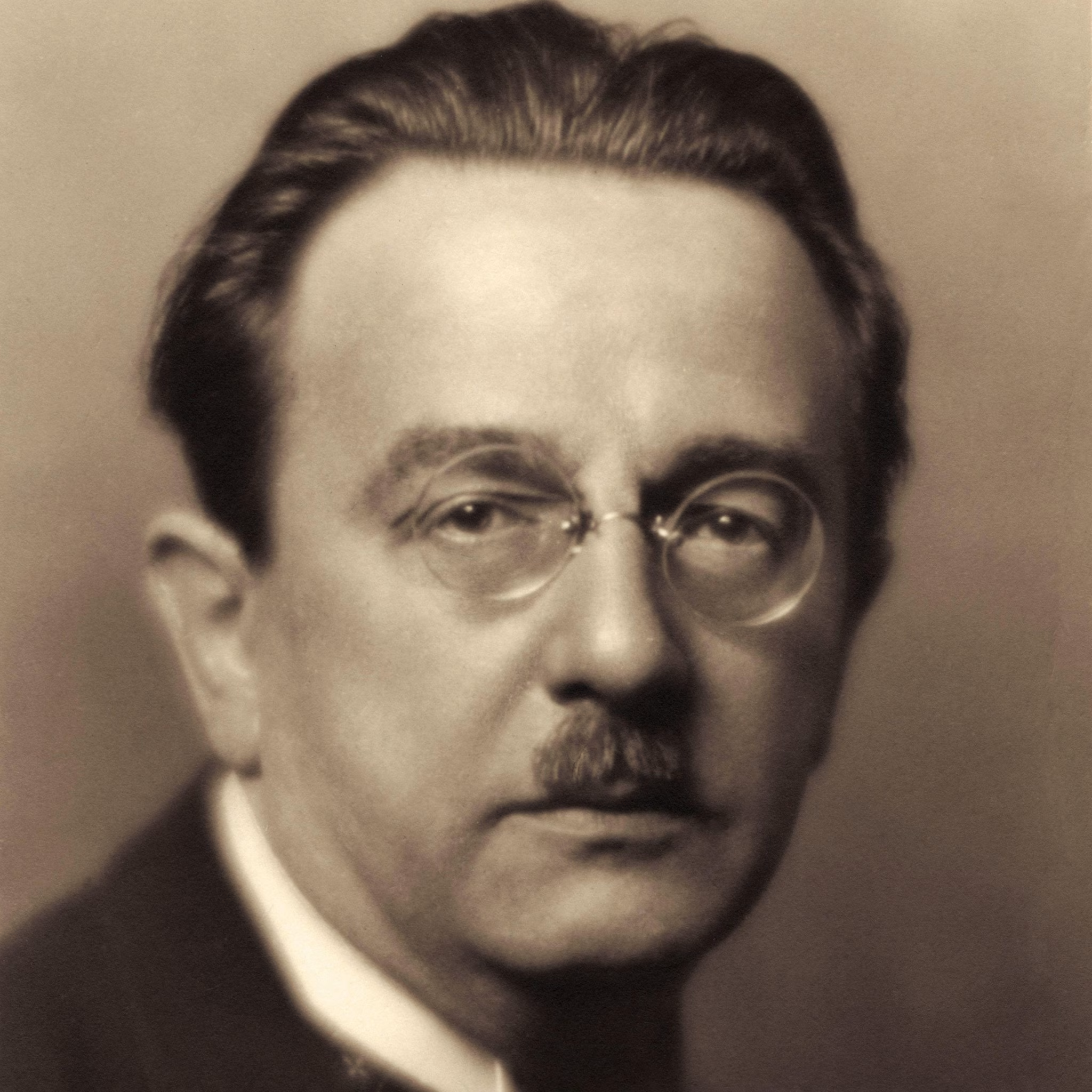
Franz Schmidt Symphony No. 4 in C Major
Symphony No. 4 in C major is regarded as the “most significant composition by Austrian composer Franz Schmidt”. His works were composed between the late 19th and early 20th centuries.

Schmidt’s masterpiece is considered his finest symphonic work, “functioning as a poignant, continuous-form requiem for his daughter,” who died unexpectedly during childbirth. The piece is defined by “intense chromaticism, deep emotional loss, and structural unity, often utilizing a recurring, mournful trumpet solo“. The four-movement symphony is “played as one continuous segment, lasting 45 minutes“. Belgrade Philharmonic soloists were phenomenal, especially the trumpet!

_____________
“Franz Schmidt Symphony No. 4 in C Major is a profound, late-romantic masterpiece and a deeply personal ‘requiem’ for his deceased daughter. It’s marked by elegiac, continuous music performed without pause.”
_____________
The “melancholic trumpet solo in the opening movement mirrors the cycle of life, death, and remembrance,” setting a “tone of reflection and grief,” followed by “prominent cello solos“.

Conductor Christoph König
Christoph König is chief conductor of Casa da Musica Symphony Orchestra in Porto Portugal and Solistes Européens Luxembourg. His style is described as “energetic and inspiring,” with interests in “stimulating, imaginative, contemporary music“. His second and third seasons in Porto featured Mahler’s symphonies, pieces by Bruckner, Ravel, Strauss, and works by more contemporary composers like Henze, Saariaho, and Pintscher, whose works are mostly unfamiliar to me.
_____________
“Christoph König has been affiliated with many of the leading opera houses in Europe, including Zurich Opera, Deutsche Oper Berlin, Bonn Oper, Semper Oper Dresden, Staatsoper Stuttgart, and Teatro Real in Madrid.” Arabella Arts
_____________
Charming König is sought after as a conductor in Europe and America. He recently debuted with the Netherlands Philharmonic Orchestra, Toronto Symphony, Orchestre de Paris, Norwegian Radio Symphony Orchestra, RTVE Radio Symphony Orchestra Madrid, BBC Philharmonic Orchestra, New Zealand Symphony Orchestra, and more. He toured China in 2008.
In the US, König conducted orchestras in New Jersey, Pittsburgh, Houston, Indianapolis, Colorado, Oregon, Baltimore, and Phoenix. Future engagements include a return to the Orchestre de Paris, Toronto and Houston Symphony Orchestras, as well as concerts with the Beethoven Orchestra Bonn, Royal Philharmonic London, Oregon and Baltimore Symphony Orchestras. In August 2025, he made his debut with the New Zealand Symphony Orchestra.
König’s versatile career encompasses conducting operas, including the premiere of Mozart’s The Abduction from the Seraglio and performances, like Rossini’s IL Turco in Italia (A Turk in Italy), Don Giovanni, The Magic Flute, and Verdi’s Rigoletto.

In addition to his many other musical accomplishments, Christoph König has made several recordings, including Nystroem’s Sinfonia del Mare with Sweden’s Malmö Symphony Orchestra and Brahms First Piano Concerto with the BBC Scottish Symphony Orchestra.
_____________
“Herbert von Karajan Foundation Prize is a music award presented to young singers and conductors whose exceptional artistic achievements have found global recognition.”
_____________
König grew up in Dresden Germany and studied orchestral conducting, piano, and voice at the music academy there. Christoph König is a recipient of the Herbert von Karajan Foundation Prize, honoring exceptional contributions to music by outstanding artists and ensembles.

Violin Soloist Sergey Khachatryan
Sergey Khachatryan was born in Armenia. In 2000, he won First Prize at the VIII International Jean Sibelius Competition in Helsinki, becoming the youngest-ever winner in the competition’s history. In 2005, he claimed First Prize at the Queen Elisabeth Competition in Brussels. During the 23/24 season, Sergey performed throughout Europe and in South Korea, North America, Australia, and his home country, Armenia.
During previous seasons, he held residency with Orquesta de Valencia, Orchestre National de Belgique, and BOZAR in Brussels. He appeared with the Orchestra dell ’Accademia di Santa Cecilia Rotterdam, Finnish Radio Symphony Orchestra, Royal Flemish Philharmonic Orchestra, and Cleveland Orchestra. He toured the US and Europe with cellist Alisa Weilierstein and pianist Inon Barnatan, performing a chamber music programme entitled Transfigured Nights, featuring the music of Shostakovich, Beethoven, and Schoenberg.
Other recent projects and awards, too numerous to include in this post, include a tour of Japan with the Nippon Foundation and a concert at the Lucerne Festival with the Vienna Philharmonic. I found his performance and stage presence compelling. His complete mastery of the violin is undeniable.
The audience didn’t want to let him go… His heartfelt encore was a “spiritual” piece from his home in Armenia, which clearly had a deep and special meaning to him. The Nagorno-Karabakh ethnic and territorial conflict between Armenia and Azerbaijan came to mind. The audience rewarded Sergey with enthusiastic applause.
The wonderful performance was a pleasant escape from dramas playing out on the world stage – a satisfying evening well spent.