


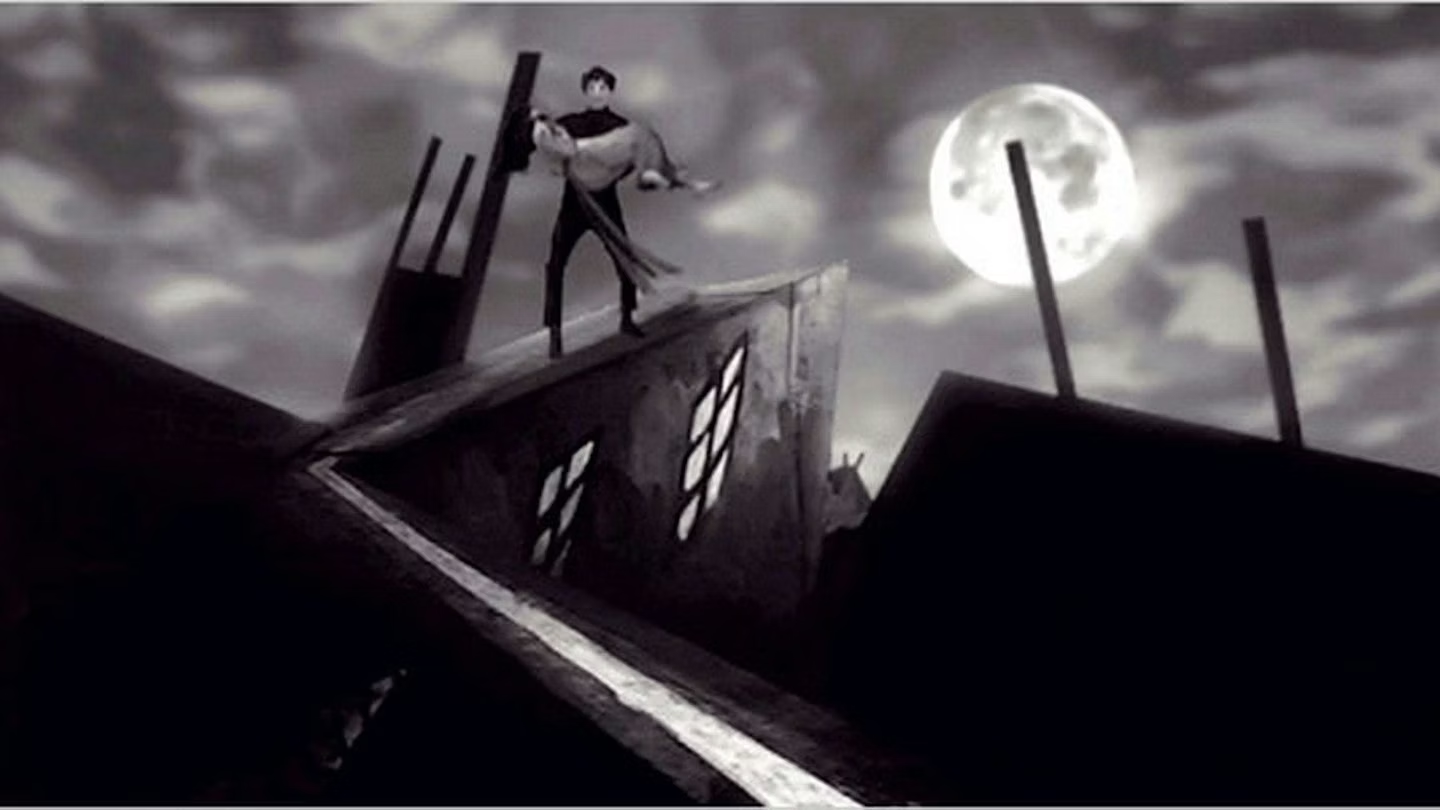
Avant-garde composer and lutenist Jozef van Wissem performed last night at a screening of the silent film, The Cabinet of Doctor Caligari, written by German expressionist Robert Wiene. The Belgrade venue – Ložionica – is an innovative center that supports creative artists. The performance included the silent film, accompanied by a live presentation of van Wissem’s unique soundtrack. His music is described as “dark, hypnotic minimalism moving from meditative passages to intense, dramatic moments, sometimes including electric guitar and sound feedback”.

The Cabinet of Doctor Caligari
The German horror film was created in 1920. The story revolves around Dr. Caligari, a hypnotist, who has control over a man named Cesare, a somnambulist (sleepwalker). Dr. Caligari “keeps Cesare in a cabinet that looks like a coffin, sometimes bringing him out to perform a sideshow telling people’s fortunes“. I know – it sounds beyond bizarre… This is a link to the full movie, with a traditional symphonic score and subtitles translated to English.

_____________
“Post-war Germany in the 1915-20s was exhausted by war, disillusioned in government, and struggling with hyperinflation and depression. During that period, the movie that manifested German expressionism as a movement was Das Cabinet des Dr. Caligari – Robert Wiene 1920. It’s considered a milestone in cinema history.” Bohema
_____________

The plot thickens! This link is a written description of the film by J. A. Hernandez. Needless to say, watching a 1920s German horror film with subtitles accompanied by lute and electric guitar music is unique 😵💫 – still processing it… Not saying I didn’t enjoy the performance, but for me, it was a unique experience.

The ending of The Cabinet of Dr. Caligari reveals that the “narrator is actually a patient in a mental asylum, and his story about the villainous Dr. Caligari and the somnambulist Cesare was a delusion“. Caligari is really the kindly asylum director, and the other characters are the narrator’s fellow inmates. 😁

Admittedly, I didn’t do enough pre-performance research about Van Wissem, the subject matter, or the venue. I booked it based on the lure of lute music – ha… It was an unexpected ultra-contemporary performance described as a “completely immersive experience, where image and sound merge into an enchanting, mysterious whole”. The performance was sold out.

_____________
“It’s like a part of my body, says Jozef Van Wissem of the relationship he has to his chosen instrument, the lute. The complexity of it keeps me going, because you can always find something new.” The Washington Post
_____________
Jozef van Wissem
Van Wissem studied the lute in New York City during the 1990s. His creative work is “equally as rooted in classical Renaissance and Baroque music, as it is in contemporary sounds, spanning drones, electronics, and field recordings”. He adds “influences from the no wave and industrial music scenes, alongside a dedicated approach to minimalism.

His creations result in distinct, singular works, with sounds that are a marriage of opposites – meditative and intense, forward thinking but with a sense of the arcane”. The Quietus, a British online music and pop culture magazine, has called Van Wissem “probably the most famous lutenist in the world”.

“For van Wissem, the lute is utterly contemporary. He can captivate a room on his own, as unafraid of ‘spare beauty’ (simplicity and minimalism) as he is of experimental gambits. When he plays, the melody’s delicate glimmer freezes the moment. He’s not only liberating the lute but also asking his audience to liberate themselves from accustomed approaches to music.”


_____________
“Musicologist Curt Sachs described the lute as composed of a body and a neck which serves both as a handle and a means of stretching the strings beyond the body. We could apply a metaphorical twist to Sachs’s words whilst listening to Jozef Van Wissem’s latest record, The Night Dwells in the Day.” The Quietus Culture Countered 2024
_____________
Counterculture Crowd
The crowd was very young, and I wanted to (but didn’t) take photos of their edgy, chic, goth, avant-garde attire – counterculture clothing described by some as “dystopian techwear, cyberpunk, goth-ninja, or modern avant-garde”. I was sure some had slipped a gummy before the performance, but marijuana is illegal in Serbia, so… The look was similar to attire I’ve seen in Berlin, Kraków, Novi Sad, and “hip” urban areas of other Balkan countries – Slovenia, Slovakia, Croatia. My first thought was that they were extras in a Dostoevsky or Kafka film.
There were a few people dressed similar to me – baggy jeans and sweater :o(. I sat next to an interesting Serbian man who spoke impeccable English and made pleasant chit chat before the performance. The music was LOUD. Some people covered their ears and several exited the performance early – lightweights for sure. The ear-piercing sound definitely blew the “cobs” out of your head and haunted you for hours afterwards! After the fact, I did some much-needed research and learned more about van Wissem, his art, and Belgrade’s impressive Ložionica.

_____________
“The minimalist music aesthetic relies on repetition, subtle rhythmic changes, and selective harmonic dissonance that resolves over the course of a movement. Many minimalist pieces incorporate steady pulses, drones, phasing tape loops, and African and Indian rhythmic concepts.” Master Class
_____________

Ložionica
“Ložionica is the first center of creative industries and innovations in the region. It’s a place where different artistic and educational forms meet. Through conferences, workshops, panels, training, residencies, coworking, and networking, Ložionica supports the development of creative industries and strengthens the capacities of individuals and teams. They organize artistic events in the fields of film, music, theater, dance, design, and visual arts.”
Ložionica is located in the Savski Venac municipality, “nestled between the Gazela Bridge, Sava River, and Belgrade Waterfront Development“. The urban area is being developed to include a Belgrade Waterfront Marina on the right bank of the Sava River.

_____________
“Ložionica – a driver of creativity and innovation – is a place where ideas become reality, and the community grows through collaboration.” lozionica.rs
_____________

Yandex Go
Ložionica is on the other side of Belgrade, a long night-walk from my apartment in Skadarlija, so I called Yandex Go – Belgrade’s Uber. Coming and going, they picked me up within 3 minutes of my call, and the drivers were polite and efficient.

In a bit of light “stupor,” I chatted with the driver who drove me home. His English was great, and he seemed approachable to ask some questions about Belgrade. When I told him how many times I’d visited, unlike most other people, he wasn’t at all shocked. We agreed that there must be some mystical déjà vu reason I’m so drawn to the place – who knows… It was an enjoyable evening, and one of the most unique I’ve spent in Belgrade.